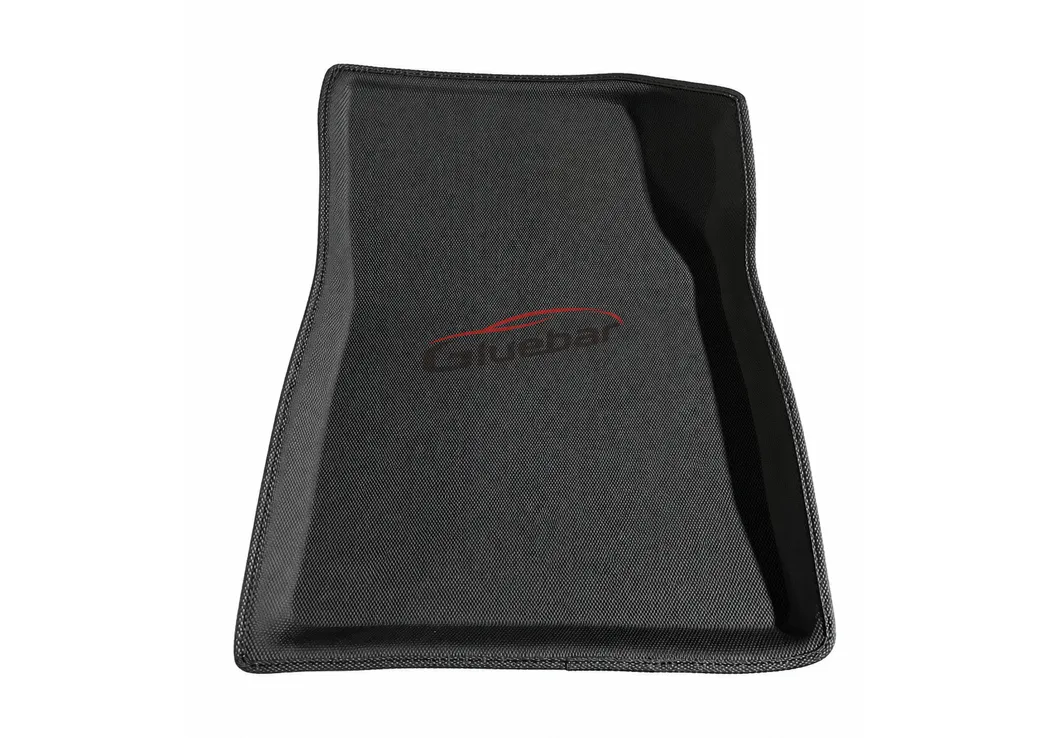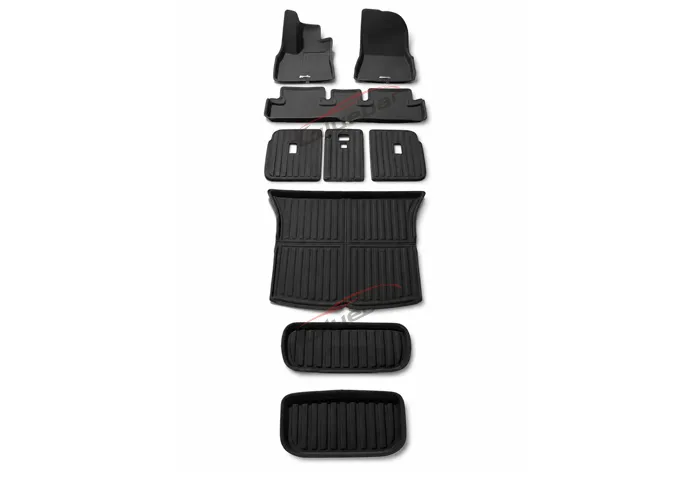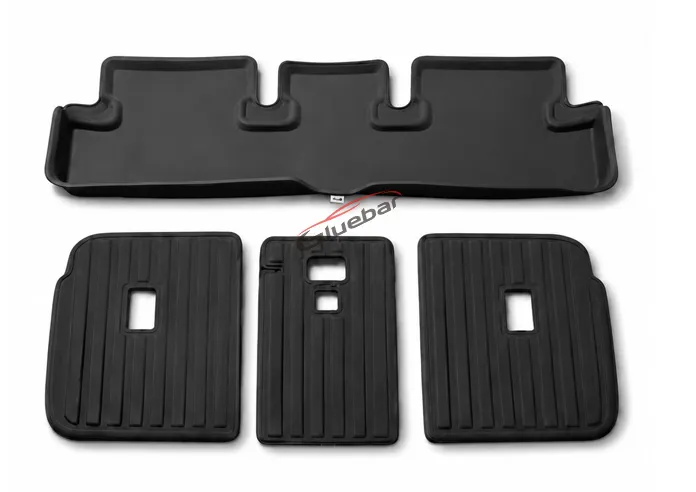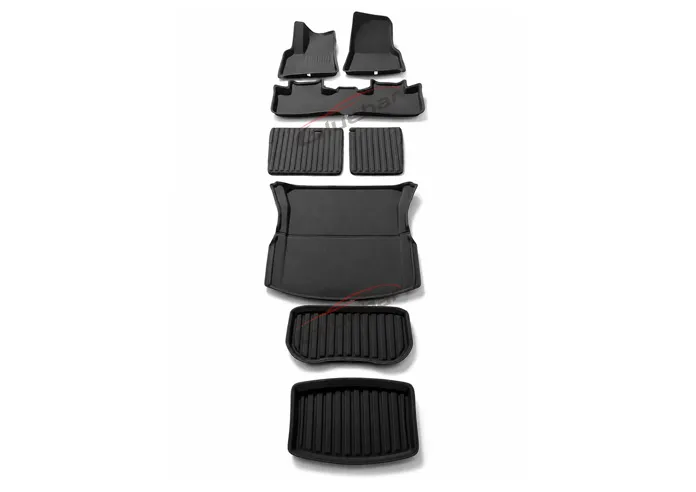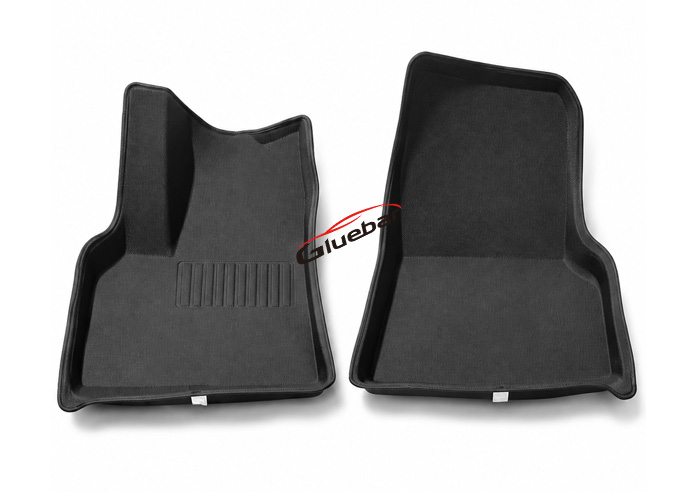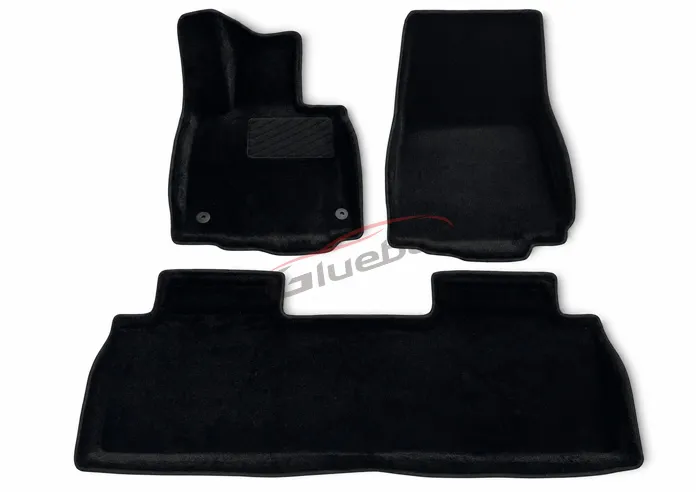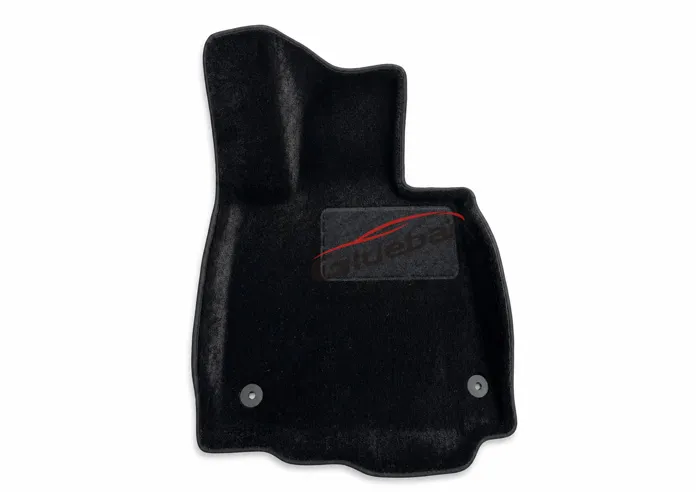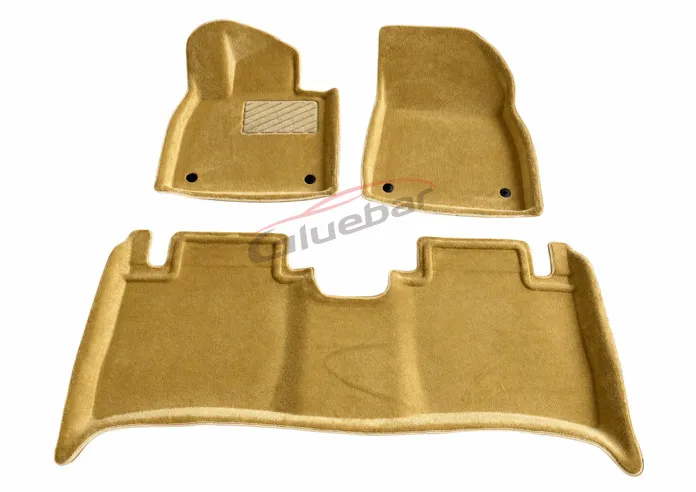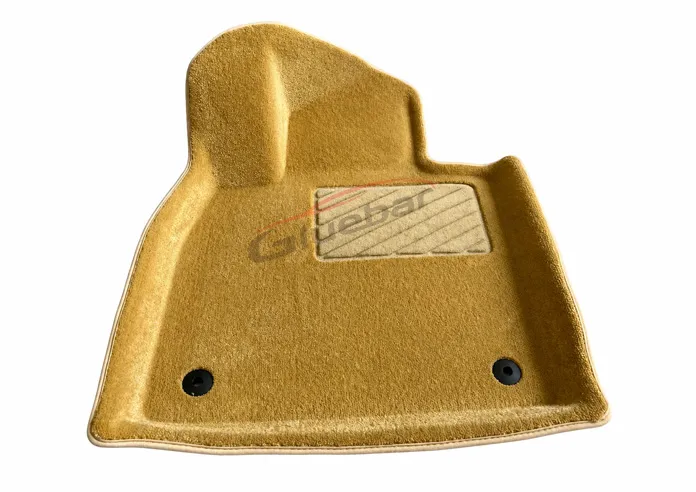
The morning sun streamed through the factory's skylights, illuminating the neatly arranged production lines.
In Gluebar's workshop, machines began to run; laminating machines heated up, and cutting machines emitted rhythmic flashes. The air was filled with the smell of hot-pressed materials as workers busily adjusted the equipment.
Every day, hundreds of car floor mats are produced here, neatly packaged and shipped worldwide.
Some of these will be used to fit high-end car models such as Mercedes-Benz.
This is no simple manufacturing process.
From material bonding and cutting to hot pressing, trimming, sewing, and quality inspection, every step requires meticulousness and experience.
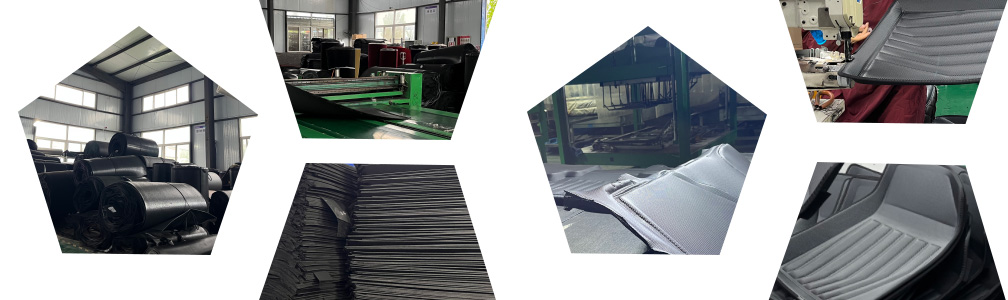
Gluebar engineers often say, "A floor mat may seem ordinary, but to truly achieve a perfect fit, durability, and aesthetics, every detail must be studied as a discipline."
Thus, these seemingly ordinary floor mats complete their journey from raw materials to finished product here.
When they are installed in the cabin of a Mercedes-Benz, the quietness, softness, and sense of security are extended from the factory to the driver's feet.
I. Composite Process: The First Step in Making Materials "One"
1. The Beginning of Material Fusion
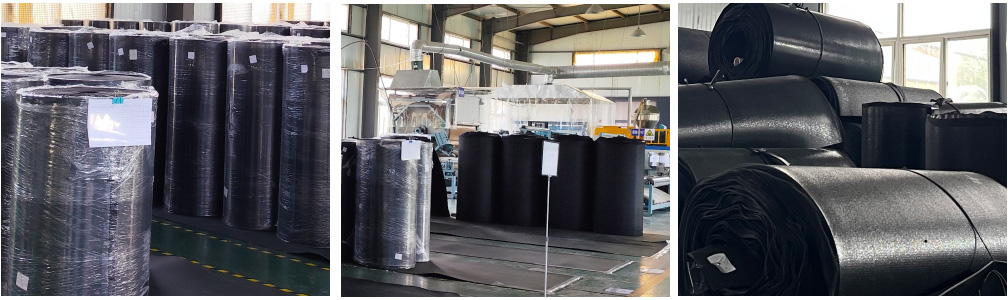
In Gluebar's production workshop, rolls of TPE, XPE, and anti-slip fiber layers are slowly fed into the laminating equipment. The temperature and pressure inside the machine are precisely controlled; every roll and every second of heating must be stable. With a deep hum from the equipment, the three layers of material are firmly pressed together at high temperature, becoming a single, strong yet elastic sheet.
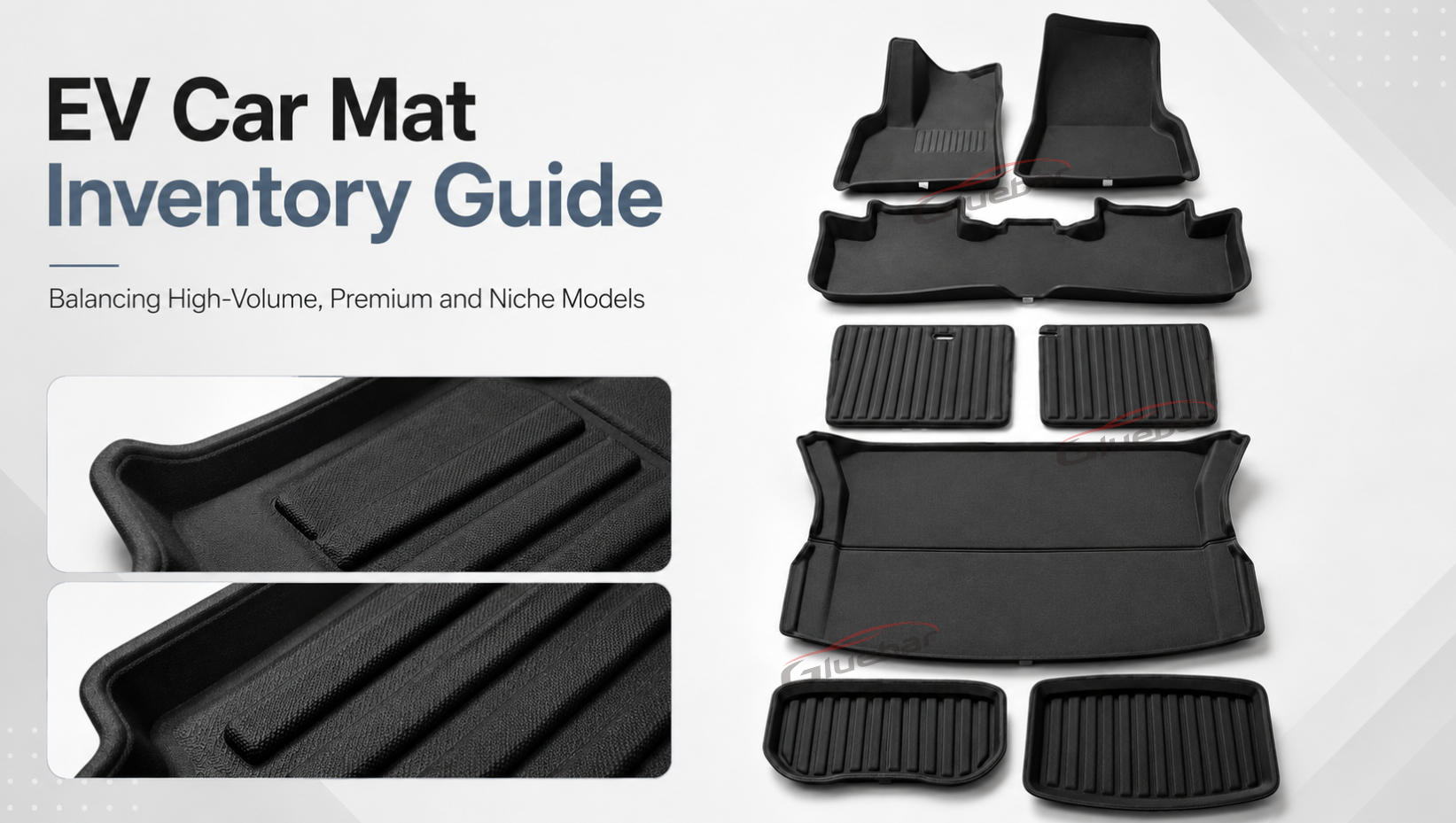
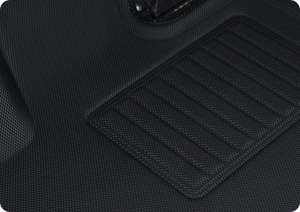
From the outside, it's just a combination of several layers of material, but at this moment, they begin to have "life." The top TPE layer provides an anti-slip and waterproof outer shell, the middle XPE layer offers soft support, and the bottom fiber layer is responsible for stability and grip. The thickness, density, and fusion temperature of the three layers are all indispensable—a deviation in any layer will affect the texture and durability of the mat.
2. A Battle of Precision and Quality
At the machine's exit, inspectors, holding thickness gauges, record parameters while observing surface texture.
"This roll is 0.1 millimeters too thick; it needs readjusting."
They know that this seemingly insignificant 0.1 millimeters could cause slight edge lifting during molding or affect mold fit.
Gluebar insists that each batch of composite materials comes with an individual number and temperature profile, preserved like a file.
This is the first line of quality control in the entire manufacturing process, and the foundation for ensuring a perfect fit for each foot pad during subsequent thermoforming.
Here, quality is not the result of a single step, but rather something written into the product's DNA from the very beginning, starting with the materials.
II. Combining Precision and Efficiency in Cutting Sheets (Cutting to Pieces)
1. From Roll Material to Cutting Preparation
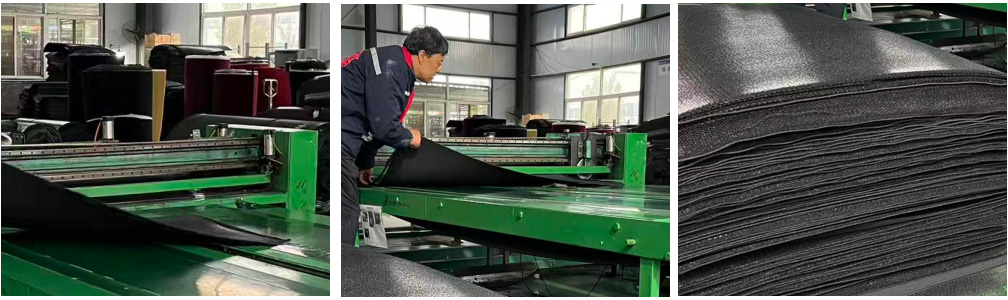
After lamination, the material is transported to the cutting workshop. A faint smell of thermoplastic fills the air as workers secure rolls of black composite sheet material to automatic cutting tables. Screens beside the machines glow blue, displaying data for each car model—different brands and models have their own independent cutting blueprints.
These blueprints aren't randomly drawn; they are generated based on the original car's 3D chassis data. The floor structures of models like the Mercedes-Benz E-Class, C-Class, and GLC differ significantly; some have gentler curves, while others have deeper rear sections. Gluebar's cutting system automatically matches the corresponding template, ensuring every cut is in the most suitable position.
2. Precise Control of Automated Cutting
When the cutting machine starts, the blade moves rapidly along a preset path, emitting a soft hum.
Here, human experience is combined with automated technology—operators monitor the blade trajectory on a screen, adjusting cutting speed and pressure in real time to prevent burrs or streaks at the edges.
The whole process looks simple, but in reality, it allows for no room for error. For a set of Mercedes floor mats, even a 0.5 mm deviation in size can lead to slight edge warping after molding. Gluebar's automated cutting system can control the error to within 1 mm; this precision is one of the reasons why it is trusted by OEM customers worldwide.
3. Sorting and Numbering, Ready for the Next Stage
After cutting, the sheets are sorted and stacked. Workers affix labels according to the car model and production batch, such as "GLC Front Left – 2025A Batch". These numbers not only facilitate mold matching during subsequent hot pressing but also allow for quick identification of problematic batches during quality inspection or traceability.
At this point, the outline of a floor mat has emerged, but it is still only a "semi-finished product". Next, it will enter a molding stage with higher temperatures and higher pressures—at that step, the material will truly "become what it is".
III. Thermoforming Process: Transforming Foot Pads from Flat to Three-Dimensional
1. The Combination of Molds and High Temperatures
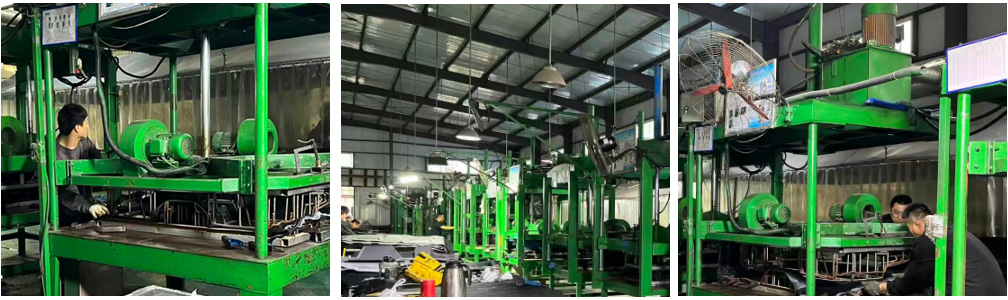
Before the cut sheets enter the next process, workers check the serial number of each piece to ensure a perfect match with the mold for the corresponding vehicle model.
These molds are designed based on the 3D data of real vehicles, like a "car cabin mold," with every curve and angle precise to the millimeter.
When the machine starts, the hot press softens the material under high temperature. The huge mold slowly closes, firmly pressing the sheet in the middle. In just a few dozen seconds, the floor mat transforms from a flat material into a "molded part" with three-dimensional lines. This step, like "sculpting," gives the material its first real shape.
2. The Key to Perfect Fit
Hot pressing may seem simple, but it determines whether the floor mats truly fit the car's floor.
Take the Mercedes-Benz E-Class and GLC as examples: their front passenger area angles, accelerator pedal depth, and rear center tunnel heights differ. Even slight deviations in mold data can cause the floor mats to warp or slip.
Gluebar's mold engineers meticulously verify each mold, immediately cooling and setting it after pressing to prevent material springback and deformation. Every floor mat produced has clean, smooth edges, achieving a fit so perfect it almost "locks" into the original car floor.
3. The Dedication Behind the Details
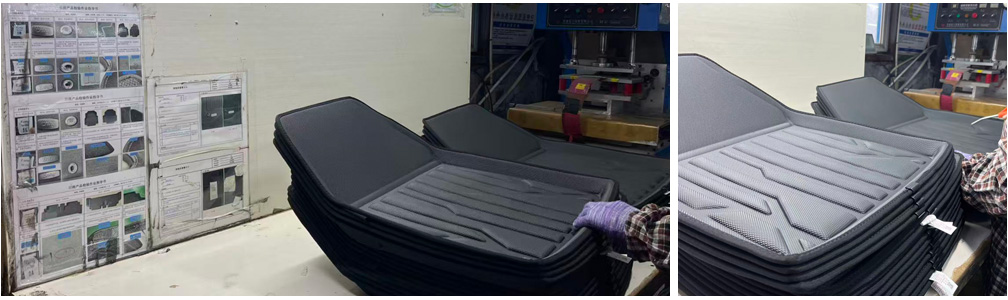
The hot-pressed car floor mats are neatly placed in the cooling area to cool down. Workers pick one up, gently press the edge to check its resilience, and feel the surface to confirm the smoothness of the texture.
These seemingly simple actions are actually part of checking the quality of the floor mats. It's often said, "When making floor mats, you can't just look at how they look; you have to feel them, examine the lines, and test the fit."
At Gluebar, a car floor mat is more than just a few layers of material. It undergoes repeated processing under high temperature, pressure, and time to transform a flat sheet into a three-dimensional shape. When it's finally installed in the car, it sits firmly on the floor without curling or slipping—that's the result of the entire team's hard work.
For Gluebar, this is not just about manufacturing a floor mat, but about a dedication to perfecting every detail.
4. Trimming the edges makes the mat's outline cleaner and more refined.
1. Every Cut Must Be Perfect
After being thermoformed, the floor mats, though already having their outline, still retain fine rough edges. At the trimming station, workers put on gloves, pick up electric trimming machines, and slowly move them along the lines of the floor mats. What seems like a simple cut actually requires considerable skill and experience. Trimming too much will ruin the mat's shape; trimming too little will leave the edges rough. This is especially true for floor mats designed for Mercedes-Benz vehicles, where the complex corners and three-dimensional bends allow for no deviation in any detail. Experienced workers often say, "Trimming is about stability, it's about craftsmanship and spirit." Their hands follow the curves across every arc, the blade and the line almost becoming one.
2. The Final Touch from Rough to Refined
After trimming, the floor mat's lines become smooth, its edges rounded, and it feels smooth to the touch without a single burr. This step, though seemingly minor, instantly elevates the finished product's character. Especially when this floor mat is placed in a Mercedes-Benz cabin, the seamless fit between its lines and the floor speaks volumes about its quality, requiring no further embellishment.
Gluebar has always insisted on hand-trimming its edges—not because machines can't do it, but because humans can "feel it." From rough to refined, from mold to detail, every cut reflects the worker's pursuit of perfect form. It is precisely these seemingly insignificant actions that transform a floor mat from an ordinary "product" into a proud "work of art."

V. Edge Sewing
1. Luxury Vehicle Edge Standards
Floor mats designed for Mercedes-Benz models have even higher requirements for detail. From the E-Class to the GLC, the footwell space differs for each car, and the edging lines must follow the curvature of the mat to ensure a natural fit under the car's floor during installation.
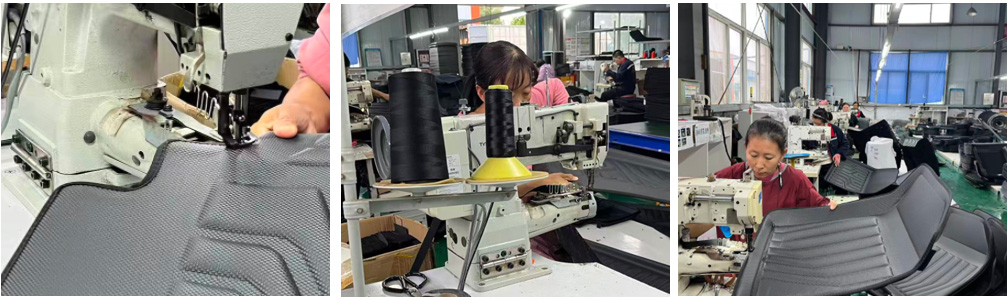
At Gluebar's edging station, the sound of sewing machines rises and falls as workers carefully stitch along the edges.
Like sewing the hem of a suit trouser, this step may seem simple, but it's actually the most skill-intensive part of the entire process.
Every stitch must be straight and steady; even a millimeter of deviation will affect the overall appearance of the floor mat.
2. Color Coordination with Interior Style
Mercedes-Benz owners often prioritize the harmony and quality of their interiors. Therefore, Gluebar selects appropriate line colors and thicknesses based on the interior of each model when edging. For example, the GLC with a dark interior uses a dignified black line, while the E-Class with a light beige interior uses a soft gray tone.
The purpose of this is not merely decoration, but to ensure that the floor mats blend seamlessly with the interior after installation, appearing neither obtrusive nor overly flashy, yet enhancing the overall sense of luxury.
3. The Warmth of Handcrafting
After the edging is finished, the craftsman gently runs his hand along the edge of the floor mat to check for even stitching and smooth edges.
They know that this final hand inspection is the "last hurdle" before the floor mats enter the car.
Every day, Gluebar's sewing station completes hundreds of sets of floor mats. Although the machines are constantly running, the edges of every floor mat carry the warmth of human touch. This warmth is not just a symbol of craftsmanship, but also Gluebar's dedication to quality—ensuring that every stitch and every thread is worthy of a detail-oriented vehicle like Mercedes-Benz.
VI. Quality Inspection and Packaging
Behind the rigorous testing lies a habit.
In Gluebar's quality inspection workshop, the air is clean and the lights are bright. Neatly stacked floor mats await inspection—the most crucial step before leaving the factory. Each floor mat undergoes multiple tests for size, fit, anti-slip properties, and appearance. For floor mats designed for Mercedes-Benz models, the standards are even higher. The lines of a Mercedes-Benz cabin floor are smooth yet subtly varied; every detail, from the front slope to the rear aisle and under the air conditioning vents, must match perfectly. Quality inspectors use laser rulers to compare key dimensions and then run their fingers along the edges to confirm smooth lines and a neat finish. "Even a one-millimeter deviation will be noticeable in the car," they say.
The anti-slip testing machine simulates the driver's repeated steps, including getting in and out of the car, and turning, running thousands of times to ensure the floor mats don't slip or curl. Only products that pass all tests are labeled as qualified. Gluebar's inspection process is never simplified because they understand that it's not just part of the product, but the starting point for the Mercedes-Benz driving experience.
Packaging: Another Kind of Ritual
Floor mats that pass quality inspection are sent to the packaging area. Workers use compressed air to blow away dust and then polish the surface with a soft cloth, ensuring each mat is clean and smooth. Under the lights, the matte texture of the TPE surface presents a calm luster, echoing the luxurious atmosphere of the Mercedes-Benz cabin. Afterwards, staff label them according to car model—E-Class, C-Class, GLC… each model corresponds to precise data. Bagging, sealing, and boxing—every step follows standardized procedures.
When the last batch of floor mats is loaded onto the pallet, the neat lines gleam softly under the lights. For Gluebar's workers, this is not the end, but a delivery ritual. Because they know that these floor mats will enter Mercedes-Benz vehicles, bringing drivers a quiet, comfortable, and orderly experience under their feet.
Make every car floor mat worry-free
Gluebar's goal has always been simple—to ensure that every floor mat perfectly conforms to the vehicle, is durable, non-slip, aesthetically pleasing, and safe. Every process and every inspection is for that unseen yet palpable peace of mind.
Whether it's a Mercedes-Benz or any other brand, Gluebar wants drivers to feel a sense of security and trust with every step they take and every start of the journey. Because for Gluebar, a good floor mat is not just about protecting the floor, but about safeguarding the ease of every trip.